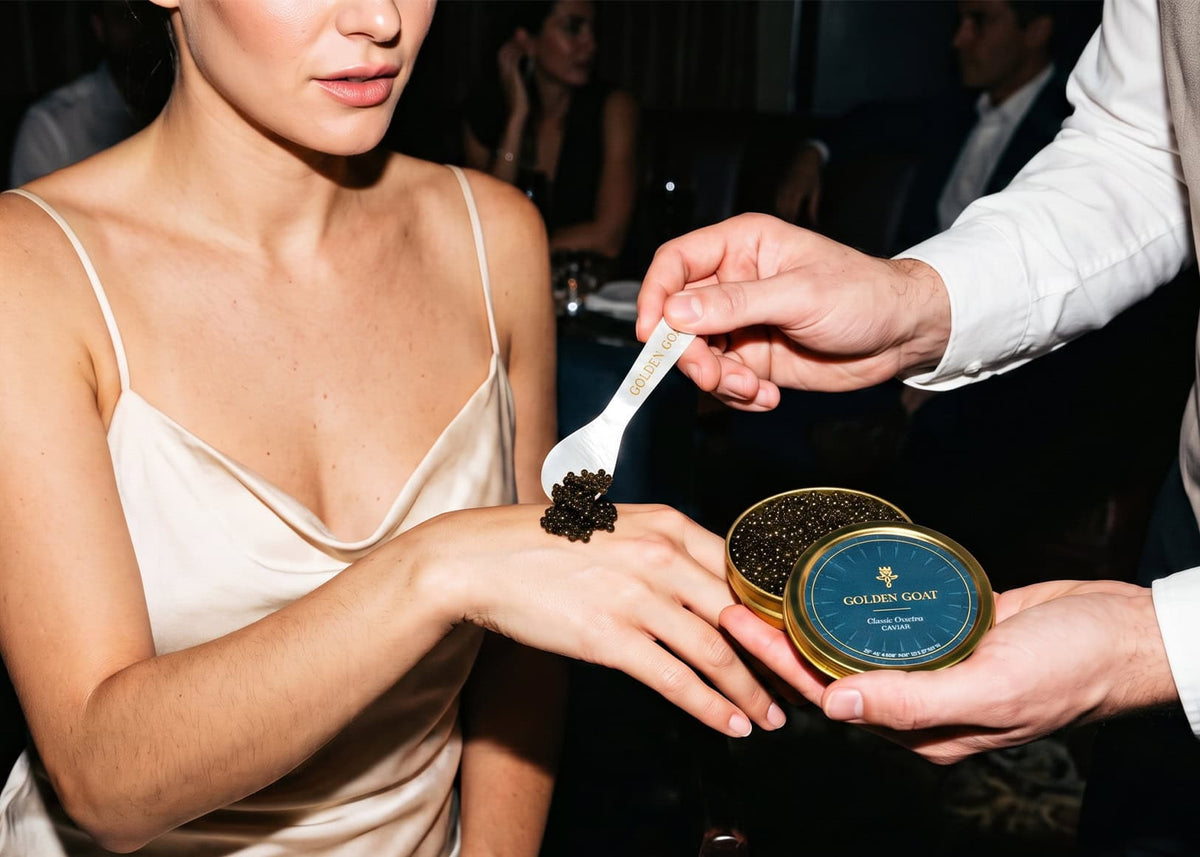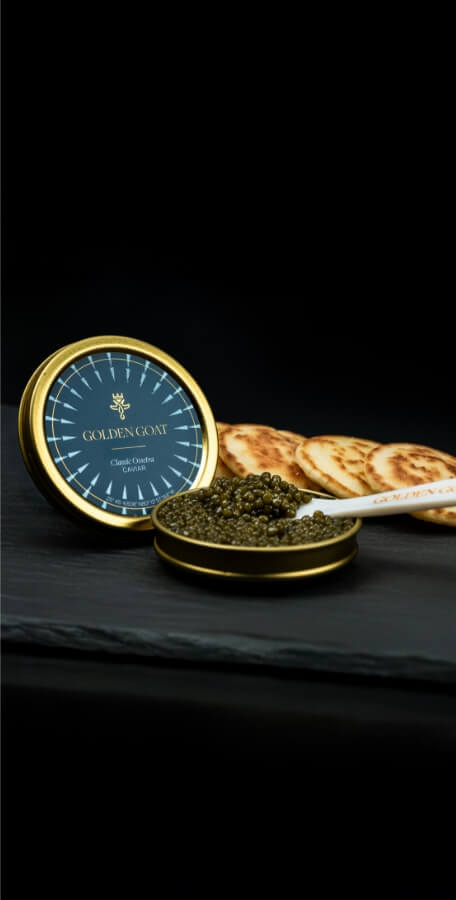

Exceptional caviar is not defined by one origin, one color, one pearl size, or one impressive-sounding label. High-quality caviar is the result of several characteristics working together: intact pearls, a texture appropriate to the variety, clean and balanced flavor, responsible sourcing, traceability, and careful handling that preserves the roe as intended.
That distinction matters because caviar resists shortcuts. Larger pearls are not automatically better. Lighter color is not a universal mark of quality. Two exceptional caviars can look, feel, and taste completely different while still beautifully representing their variety.
At Golden Goat Caviar, our published approach to quality starts with responsible sourcing and farm-to-tin traceability, then looks at the characteristics that define each caviar, including pearl integrity, texture, flavor, and freshness. Rather than expecting every variety to look or taste the same, we select caviars that express their character while meeting the standards Golden Goat sets for quality and handling.
When the ingredient list is essentially roe and salt, every detail has somewhere to show up.
What Makes Caviar High Quality?
High-quality caviar is about balance rather than one headline feature. The pearls should retain their integrity, present naturally for the variety, separate cleanly, and deliver an appropriate texture, aroma, and flavor without objectionable or stale notes.
Research from the University of Florida supports a broader view of caviar quality. The Institute of Food and Agricultural Sciences notes that quality is influenced by factors including the sturgeon species, culture conditions, maturity of the roe, processing and storage protocols, with firmness, texture, and other sensory characteristics contributing to the final experience.
Judging caviar by pearl size alone misses much of the point. Different varieties naturally express themselves differently, and quality should be considered within that context rather than against one arbitrary visual ideal.
A beautifully generous pearl can be part of one caviar's personality, while another earns admiration through a different combination of structure, texture and flavor. Neither needs to imitate the other to be exceptional.
For readers still learning their way around caviar varieties, our Beginner's Guide to Caviar goes deeper into the fundamentals.
→ Read our blog: New to Caviar? A Complete Beginner's Guide to Types, Taste & How to Eat It
How Is Caviar Evaluated and Graded?
Quality caviar evaluation considers characteristics such as pearl integrity, size, uniformity, appearance, firmness, separation, aroma, flavor, and overall condition. Terminology may vary between producers and suppliers, which is why names such as Royal or Imperial should not automatically be interpreted as one universal regulated grading hierarchy.
Caviar grading is more nuanced than a single worldwide score.
The international Codex Standard for Sturgeon Caviar focuses on sensory examination, consistency, condition, odor, and flavor. It looks for defects such as broken eggs, fluid, undesirable odors or flavors, and problems with grain structure. There is no simple global ladder where one pearl size or marketing term automatically outranks another.
In other words, grading is less about finding one perfect-looking pearl and more about understanding how the complete product presents itself.
Pearl Size, Uniformity, and Appearance
Appearance makes the introduction, but it does not write the entire review.
Well-defined pearls with natural sheen and good integrity are useful quality signals, while size and color should be understood in relation to the species or variety rather than judged against one universal standard. Caviar can vary substantially in appearance and still be entirely characteristic of what it is intended to be.
This is also why "bigger is better" is too simplistic. Pearl size can contribute to a particular tasting experience, but it is one of many characteristics.
The more interesting question is whether the caviar looks intact, well handled, and true to its expression.
Firmness, Separation, and Texture
Texture is where visual quality becomes something you can actually experience.
Well-handled pearls should retain their structure and separate appropriately rather than breaking down into excessive liquid. The Codex standard specifically identifies broken eggs, fluid, and problems with grain consistency as relevant defects when evaluating sturgeon caviar.
The University of Florida likewise identifies firmness and texture among the sensory qualities influenced by how caviar is produced and handled.
Not every variety delivers the same sensation on the palate. Some pearls may feel firmer or more pronounced, while others create a softer or silkier experience. The goal is not uniformity across the entire category. It is integrity within the caviar itself.
Aroma, Flavor and Balance
Flavor gets the final vote.
Good caviar should have a clean aroma and a balanced flavor profile that lets the natural character of the roe come through. Depending on the variety, that character can move through buttery, nutty, briny, mineral, or subtly oceanic territory.
What matters is composure.
The Codex standard identifies persistent objectionable odors or flavors associated with decomposition, oxidation, or contamination as defects, reinforcing the importance of clean aroma and flavor in assessing caviar condition.
The opposite is far more enjoyable: balance, clarity and the inconvenient realization that one spoonful has made another seem entirely reasonable.
Which Quality Signals Matter in Fresh Caviar?
When evaluating caviar quality, it helps to consider the complete experience rather than searching for a single supposed sign of perfection.
| Quality Signal | What to Look For | Why It Matters |
|---|---|---|
| Pearl integrity | Intact, well-defined pearls | Helps preserve the intended texture and presentation |
| Appearance | Natural sheen, with size and color appropriate to the variety | Reflects the natural character of the caviar rather than one universal visual ideal |
| Texture | Appropriate firmness and clean separation | Forms a major part of the tasting experience |
| Aroma and flavor | Clean aroma, balanced salinity, and a clear finish | Allows the character of the roe to remain the focus |
| Freshness | Correct refrigeration and careful handling | Helps protect texture, aroma and flavor until serving |
No single column wins the argument by itself. Premium caviar expects the whole package.
Why Does Caviar Freshness and Handling Matter?
Freshness is about protecting everything that made the caviar worth selecting in the first place. Careful refrigeration and handling of caviar help preserve its intended texture, aroma, and flavor until the tin is opened.
Golden Goat caviar is fresh, minimally salted malossol caviar. Each tin contains sturgeon roe and salt, with no preservatives, additives, or artificial ingredients. We do not use heavy pasteurization, which can compromise the quality of the roe.
Malossol means "little salt" and refers to caviar prepared with relatively low levels of salt. The restrained approach allows the roe's natural character to remain at the center of the experience.
Exceptional caviar needs very little interference. Its character should be allowed to speak for itself.
What Does Fresh Caviar Look, Feel, and Taste Like?
Fresh caviar should retain the structure and texture intended for the variety, while its aroma and flavor should remain clean and characteristic rather than showing stale or objectionable notes.
Storage plays a practical role in protecting those qualities. Storage protocols are among the factors that influence caviar quality, while the Codex standard provides requirements around storage and temperature information for sturgeon caviar.
For Golden Goat Caviar specifically, we recommend storing unopened caviar in the coldest part of the refrigerator at 32°F to 38°F, or 0°C to 4°C, and enjoying an opened tin within 24 to 48 hours for peak flavor and texture. We also advise against freezing caviar, as freezing can damage the delicate structure of the pearls and alter both texture and taste.
Finding a reason to finish an open tin within 48 hours has never struck us as one of life's more difficult assignments.
For our complete storage, serving, and traceability guidance, explore the Golden Goat Caviar FAQs.
What Does Sustainable Caviar Sourcing Mean?
Responsible caviar sourcing deserves more detail than simply putting the word "farmed" on a label and moving on.
Aquaculture practices can differ substantially, which means farmed production should not automatically be treated as proof that every operation follows the same environmental or traceability standards.
Responsible aquaculture can involve considerations including:
- Water management
- Traceability
- Welfare
- Species protection
- Feed and waste management
- Controls used by individual facilities
At Golden Goat, we source responsibly farmed sturgeon from certified aquaculture facilities. Our partners follow standards relating to environmental welfare, species protection, water quality and full farm-to-tin traceability.
We also work with Brand Reputation through Compliance Global Standards (BRCGS), Safe Quality Food (SQF), and SGS-accredited farms that use responsible aquaculture systems such as Recirculating Aquaculture Systems (RAS). These accreditations and systems form part of our broader sourcing framework and should not be mistaken for a single universal sustainability certification.
Each Golden Goat tin includes traceability information, including the species, batch number, harvest date, and country of origin. We maintain farm-to-tin documentation across our partner farms.
Sustainability is a serious subject, and specifics have better manners than slogans.
Four Standards for Golden Goat Caviar Selection
Our published approach to quality starts with responsible sourcing and farm-to-tin traceability, then looks at the characteristics that define each caviar, including pearl integrity, texture, flavor, and freshness. Rather than expecting every variety to look or taste the same, we select caviars that express their character while meeting the standards Golden Goat sets for quality and handling.
Our collection includes caviars with different species, flavor profiles, pearl sizes, and textures.
Quality has to make sense within the caviar itself. A larger pearl may form part of one variety's identity. Another may impress through a firmer structure, a different flavor profile, or a more refined finish. We are not trying to make every tin taste interchangeable.
That would defeat the point of having a collection.
1. Responsible Sourcing and Traceability Set the Foundation
Before texture or flavor enters the conversation, we start from our published sourcing position: responsibly farmed sturgeon from aquaculture facilities, supported by farm-to-tin traceability across our partner network.
This gives the product a documented foundation before anyone reaches for a caviar spoon.
2. Quality Should Reflect the Variety
Our Golden Goat collection spans caviars with different pearl sizes, textures, and tasting profiles because there is no reason exceptional caviar should all look alike.
Ossetra and Kaluga, for example, offer different pearl sizes, textures, and flavor profiles, allowing each variety to bring its character to the collection.
Those differences are not quality problems to be corrected. They are the reason exploring caviar is interesting.
3. Flavor Is Where It All Comes Together
Appearance may start the conversation, but the caviar ultimately has to taste good.
Our collection offers distinct flavor profiles rather than variations on the same idea, allowing people to explore caviar according to the character of each variety.
A collection should offer choices, not twelve versions of the same opinion.
4. Freshness Protects What Came Before It
The care invested in sourcing and selection only matters if the caviar reaches the table in the condition intended.
That is why our published handling guidance emphasizes proper refrigeration, why we recommend enjoying opened caviar promptly, and why our caviar contains roe and salt without preservatives, additives, or artificial ingredients.
Freshness is not a separate badge competing with every other quality signal. It is what helps preserve them.
What Should You Look for When Buying High-Quality Caviar Online?
You should be able to identify the caviar variety, understand how the product should be stored and handled, read meaningful descriptions of its texture and flavor, and find credible information about sourcing and traceability.
Once you understand what makes caviar high-quality, buying it online becomes considerably less mysterious.
The goal is not to turn every purchase into a forensic investigation. It is simply about having enough information to understand what you are buying and how it should be handled once it arrives.
Words like "premium" and "exceptional" certainly have their place. Details make them considerably more persuasive.
→ Explore the Golden Goat Caviar Collection
Exceptional Caviar Is All About the Details
Perhaps the most useful thing to understand about high-quality caviar is that there is no single trick to recognizing it.
It is not automatically the largest pearl, the palest color, or the most impressive-sounding grade. Quality emerges when the sourcing is considered, the pearls are in good condition, the texture suits the variety, the flavor feels balanced, and the caviar has been handled carefully enough to preserve what made it worth selecting in the first place.
That is the philosophy behind the Golden Goat collection. We do not ask every caviar to imitate the one beside it. We want different varieties to express their character, and every tin in the collection to offer a reason for being there.
Because understanding what makes caviar high-quality is useful. Discovering the differences for yourself is considerably more fun.
→ Explore the Golden Goat Caviar Collection
Still deciding where to begin?
Frequently Asked Questions About Caviar Quality
What makes caviar high quality?High-quality caviar is defined by a combination of characteristics rather than by a single feature. Pearl integrity, appropriate appearance, texture, clean aroma, balanced flavor, sourcing, traceability, and careful refrigeration all contribute to the final experience. Quality should also be considered within the variety rather than assuming that one pearl size or color is universally superior. |
Does a larger pearl size mean better caviar?No. Larger pearls can be highly desirable in varieties known for that characteristic, but pearl size is not a universal quality score. Different sturgeon varieties produce different expressions, so size should be considered alongside texture, integrity, flavor, and overall condition rather than treated as proof of superiority. |
How is caviar graded?Caviar may be evaluated using characteristics such as size, uniformity, appearance, firmness, separation, aroma, flavor, and condition. Terminology can vary among producers and suppliers, so terms such as Royal or Imperial should not be treated as part of a single, globally regulated quality hierarchy. International Codex standards focus instead on sensory quality, consistency, condition, and identifiable defects. |
How can you tell if caviar is fresh?Fresh caviar should retain the intended structure and texture of the pearls, with a clean aroma and flavor characteristic of the variety. Correct refrigeration helps protect those qualities. For Golden Goat Caviar, we recommend storing between 32°F and 38°F, or 0°C and 4°C, and enjoying opened tins within 24 to 48 hours for peak freshness. |
Is farmed caviar sustainable?Farmed production does not automatically mean every operation follows the same sustainability practices. Responsible aquaculture can involve considerations such as traceability, water management, welfare, species protection, and facility controls. At Golden Goat, our published sourcing standards include responsibly farmed sturgeon, partner aquaculture facilities, and farm-to-tin traceability. |
How does Golden Goat select its caviar?Our published approach to quality begins with responsible sourcing and farm-to-tin traceability, then considers the characteristics that define each caviar, including pearl integrity, texture, flavor and freshness. We select caviars that express their own character rather than expecting every variety to look or taste identical, while applying Golden Goat's published quality and handling standards. |